

Automotive Software Quality, Proven by A-SPICE CL2
Duck-il Industry achieved Automotive SPICE Capability Level 2 certification in May 2024.
We run a software quality framework linked to CMMI Level 3, ISO 26262 functional safety and our SPQA “A” rating.
What Does CL2 Certification Mean?
The meaning and scope of A-SPICE CL2, answered question by question.
What is A-SPICE Capability Level 2?
Automotive SPICE is an international standard model for assessing the maturity of automotive electronics software development processes. Capability Level 2 (Managed) means that processes are planned, monitored and adjusted, and that work products are managed in line with their requirements. Duck-il Industry achieved CL2 certification in May 2024.
What does the CL2 certification cover?
Based on the VDA Scope of Automotive SPICE 3.1, the CL2 certification covers 15 processes in total: 4 SYS (system), 6 SWE (software), 4 SUP (support) and 1 MAN (management).
The detailed scope is as follows.
SYS · System 4
- SYS.2 System Requirements Analysis
- SYS.3 System Architectural Design
- SYS.4 System Integration and Integration Test
- SYS.5 System Qualification Test
SWE · Software 6
- SWE.1 Software Requirements Analysis
- SWE.2 Software Architectural Design
- SWE.3 Software Detailed Design and Unit Construction
- SWE.4 Software Unit Verification
- SWE.5 Software Integration and Integration Test
- SWE.6 Software Qualification Test
SUP · Support 4
- SUP.1 Quality Assurance
- SUP.8 Configuration Management
- SUP.9 Problem Resolution Management
- SUP.10 Change Request Management
MAN · Management 1
- MAN.3 Project Management
What value does it bring to OEM customers?
Automakers assess quality risk and production stability by looking at the process maturity of their suppliers. A-SPICE CL2 demonstrates the capability to plan and carry out development and verification activities according to defined processes and to manage the resulting work products systematically. This raises confidence in the delivery, quality and SPQA audit readiness of our automotive software products, including seat switches, lighting and controllers.
What comes after CL2?
In 2025 we are advancing AUTOSAR BSW and Gap Analysis, and in 2026 we are pursuing CL-3 (Defined Process with A-SPICE) along with more advanced cybersecurity processes. In parallel, we continue to align these efforts with our ISO 26262 functional safety process.
How does it relate to the SPQA “A” rating?
SPQA is Hyundai Motor Group's software process quality assessment. In 2024 we earned an A rating and were named a best-practice supplier development case, confirming through a customer assessment that our A-SPICE-based processes are effectively put into practice.
CMMI · ISO 26262 · A-SPICE
The three frameworks that underpin our automotive software quality.
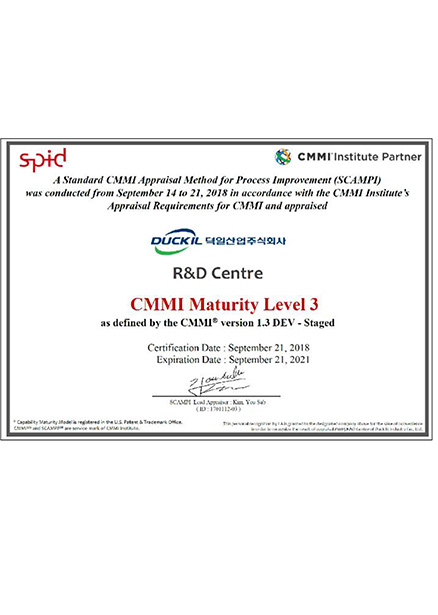
CMMI Level 3
Established in September 2018. Defined organizational standard processes deliver consistency and reproducible quality across every project.
- Definition and deployment of organizational standard processes
- Project planning, monitoring and measurement
- Foundation for A-SPICE-based process improvement
ISO 26262 Functional Safety
A dedicated functional safety team runs and assesses the process and supports functional safety audits led by Hyundai and Kia.
- Safety Goal / Requirements definition
- Safety Mechanism design and verification
- Linked HW failure rate analysis, including FMEDA
- Work product management in Codebeamer
A-SPICE CL2
Certified in May 2024. Engineering and support activities run on managed processes, and defined processes are being expanded toward CL3.
- Standard Process with A-SPICE
- Requirements–design–test traceability
- SWE.4 / SWE.5 unit and integration verification support
- Linked to the SPQA “A” rating
A-SPICE Capability Roadmap
Raising process maturity step by step, from achieving CL2 to advancing to CL3.
A-SPICE CL-2 Achieved
Official Capability Level 2 certification and Standard Process with A-SPICE in place. SPQA “A” rating and best-practice supplier development case.
AUTOSAR BSW Enhancement
Broader AUTOSAR BSW adoption, Gap Analysis-based process improvement and closer alignment with ISO 26262.
CL-3 in Progress
Working toward Defined Process with A-SPICE while advancing our cybersecurity processes.
System and Software Development Process
Our A-SPICE engineering flow keeps traceability from requirements through to verification.
Design · Implementation
System Requirements · Architecture
Customer requirements analysis, system function definition and HW/SW partitioning
SW Requirements · Architecture
Function allocation, module interfaces and platform architecture
Detailed Design · Coding
Algorithm implementation in line with coding standards such as MISRA
Verification · Testing
Unit Verification
Static and dynamic analysis and unit testing with tools such as VectorCAST
SW Integration · Software Testing
Module integration and requirements compliance testing with tools such as CANoe
System Integration · Vehicle Testing
System integration test (SYS.4), system qualification test (SYS.5), function checks with integrated HW, customer specification verification, HILS
Explore More R&D
Continue to our R&D Center, Quality Lab and patent portfolio.